4 min read
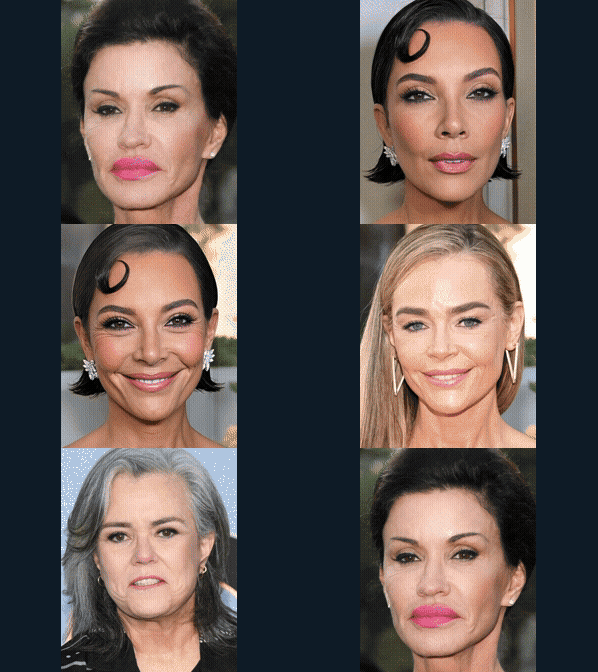
Every week someone asks me the same question: "Who did Kris Jenner's facelift?" Sometimes it's Sharon Osbourne. Sometimes it's Denise Richards. Sometimes it's Rosie O'Donnell, Ricki Lake, Jane Fonda, or Kathy Griffin. What they're really asking is why some facelifts look effortless while others immediately look like someone has had surgery.
As a double board certified plastic surgeon in Beverly Hills with more than 22 years of experience caring for patients and performing plastic surgery of the breast, body, and face, I've learned something that surprises most people.
The best facelift is usually the one nobody notices.
People assume a great facelift is all about pulling the skin tighter. It isn't. In fact, after all these years, I don't even look at faces the way most people do anymore. I notice balance. I notice volume. I notice how light reflects across the cheeks. I notice whether the face still moves naturally. Most importantly, I notice whether someone simply looks refreshed or whether I can tell they've had surgery.
Youth isn't created by stretching skin. Youth comes from shape, contour, softness, gentle transitions, and facial volume. Those are the things our eyes naturally associate with youth. That's why some celebrity facelifts look extraordinary while others never quite look right.
One face was tightened.
The other was restored.
There is a tremendous difference between the two.
If I could add one thing to almost every facelift, it wouldn't be more tightening.
It would be volume.
Youth isn't tight. Youth is full.
That's one of the reasons I almost always discuss facial fat grafting with my facelift patients. Yes, we naturally lose volume as we age, but replacing that volume isn't simply about filling space. When fat is carefully harvested and strategically placed, it restores the natural curves of the face and changes the way light reflects across the skin. It softens transitions between the eyelids and cheeks, restores the temples, supports the jawline, and helps create a face that looks naturally youthful instead of surgically tight.
One of the most overlooked benefits of fat grafting is the quality of the skin itself. Your own fat contains living cells that help support healthy tissue. In my experience, patients who undergo facial fat grafting often notice improvements in skin texture, skin quality, and overall softness as everything heals. Just as importantly, adding volume where it belongs allows the facelift to settle more naturally. Instead of relying on tension to create a younger appearance, the face is supported from within. That almost always creates a softer, more elegant result.
Something else many patients don't realize is that surgery is only part of the journey. Recovery plays an enormous role in the final outcome. Swelling changes. Fat grafts establish a new blood supply. Incisions continue to mature. Scar tissue softens. This is why I follow my facelift patients closely after surgery. I typically recommend planning about two weeks away from your normal schedule, followed by regular visits over the next several weeks so I can monitor healing, evaluate your progress, and treat scars with CO2 laser when appropriate. Beautiful results aren't created on the day of surgery. They continue to develop over the months that follow.
People are often surprised to learn that one of the greatest influences on how I perform facelifts today actually began much earlier in my career.
Long before I specialized in advanced facial rejuvenation, I performed many laparoscopic procedures that required working with a scope deep inside the body. Whether operating around the appendix or other delicate structures, those procedures demanded precision, patience, exceptional hand control, and an intimate understanding of anatomy. You're navigating through tiny openings while working around some of the body's most delicate tissues.
Years later, when I began performing advanced endoscopic deep plane facelifts, those same skills felt remarkably familiar. The anatomy is different, but the principles are the same. Working through an endoscope allows precise visualization of the deeper facial structures and the SMAS layer while minimizing unnecessary trauma to the surrounding tissues. Looking back, I realized those early years had prepared me in ways I never expected.
Then there was another chapter that shaped the way I practice today.
During the liposuction boom of the 1990s, my patients and colleagues affectionately nicknamed me the "Lipoqueen." I performed an extraordinary number of liposuction procedures, which meant I also became highly experienced at harvesting fat gently and preserving its quality. At the time, I never imagined those years would one day become one of the greatest advantages in facial fat grafting.
Today, every facelift I perform benefits from those experiences. Harvesting healthy fat isn't just about removing it. It's about respecting the tissue, handling it delicately, and placing it precisely where it can create the most natural, lasting improvement.
Today, whether I'm looking at a celebrity facelift, evaluating another surgeon's work, or planning surgery for one of my own patients, I'm asking myself the same question.
Does this person simply look like the best version of themselves?
If the answer is yes, then the surgery has done exactly what it was supposed to do.
Because the greatest compliment after a facelift isn't someone asking, "Who was your plastic surgeon?"
It's hearing someone say,
"You look amazing."
"You look so refreshed."
"You've been glowing lately."