01
Ideal Candidates For a Facelift
Often, individuals interested in a facelift procedure are frustrated by advanced lines and wrinkles in the mid or lower regions of the face. Facelift surgery can target one or more areas, depending on your personal needs. It is important to note that age won't always define the most effective time to have cosmetic facial surgery. There are numerous unique aspects, as well as multiple lift types, to inform the choice. The method performed will vary for candidates under 50 versus those in their 60s and 70s. Skin laxity is one of the key elements in the decision-making process. Further, facelift patients need to be in good overall health, be a nonsmoker, and approach the procedure with realistic result expectations.
02
Surgical Facelift Technique
Regardless of your aesthetic concerns, a facelift is planned by zone. The upper, middle and lower face age at different rates, so the plan usually combines two or three of the areas below. In each one the deeper support layer is repositioned rather than the skin alone being pulled, which is what keeps the result looking like you. Eyelid surgery, fat grafting or a small amount of filler is often added to complement the lift.
- Brow Lift
The upper third often gives the first signs: the brow descends, the forehead lines deepen, and skin settles over the upper lids. A brow lift resets brow position and opens the eye area, and it can be done endoscopically through short incisions hidden in the hair. Upper blepharoplasty is frequently added when excess lid skin remains.
- Mid Face Lift
The mid face is where cheek support drops and the folds beside the nose and mouth deepen. A mid face lift repositions the cheek support and the fat pad over it, softening the nasolabial folds and the marionette lines without overfilling the face.
- Lower Face & Neck Lift
The jawline, jowls and neck contour are what most patients notice first. This lift repositions the lower facial support, tightens the platysma muscle in the neck, and removes excess skin so the jawline reads cleanly and the neck sits smoother. Submental platysmal plication and neck lift are performed within this zone when the neck needs separate attention.
03
Incisions
Both are deep plane facelifts. The endoscopic incision plan is on the left; the traditional open plan is on the right.
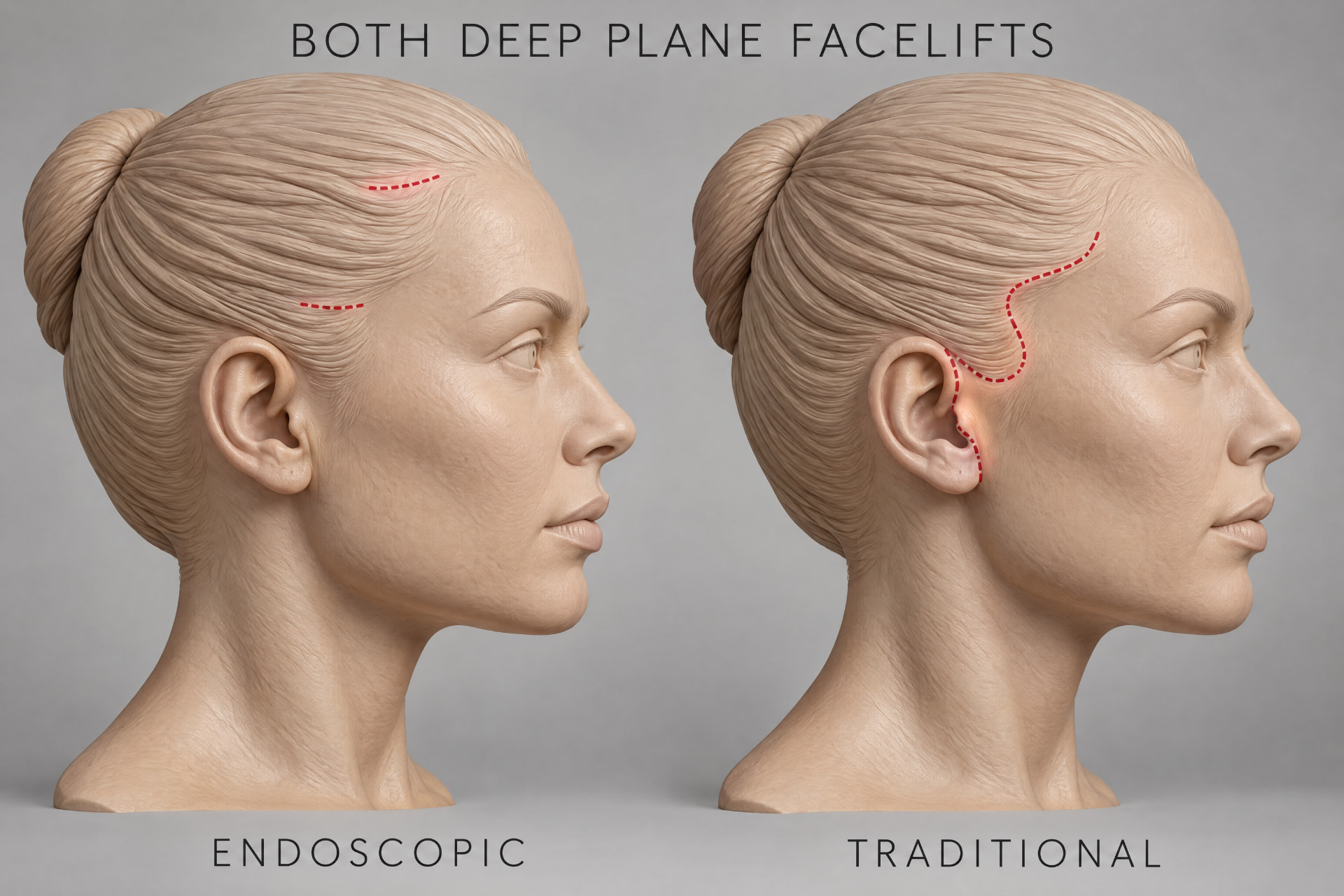
Endoscopic deep plane
An endoscope and instruments work through smaller incisions hidden in the hair, with less scarring. Dr. Trott lifts the deeper tissues in a more vertical direction. Suitable patients avoid an incision in front of the ear.
Traditional deep plane
Open access uses longer incisions from the hairline around the ears. Dr. Trott’s traditional technique uses a more lateral pull and allows more excess skin removal. Scars follow the hairline and natural ear contours.
Illustration shows typical placement. Your own plan depends on skin excess, facial support, neck contour, hair pattern and prior treatment. Hidden incisions are still incisions.
The comparison
| What you care about | Skin-only lift | SMAS lift | END-of-Aging Endoscopic Deep Plane Facelift | Traditional Deep Plane Facelift |
|---|---|---|---|---|
| What gets moved | Mostly skin | Support layer tightened or repositioned | Skin + fat + SMAS as one unit | Skin + fat + SMAS as one unit |
| Ligaments | Usually left intact | Varies by technique | Released so the face can rise | Released so the face can rise |
| Direction of lift | Skin redraping; direction varies | Tailored to the technique | More vertical lift | More lateral pull |
| Surgical access | Open access | Open access | Endoscope through smaller incisions | Open access through longer incisions |
| Scarring | Longer incision pattern | Longer incision pattern | Less scarring; incisions hidden in the hair | Longer scars around the ears |
| Midface / cheek | Does not directly reposition deep cheek tissue | Depends on the approach | Targets descended cheek tissue | Targets descended cheek tissue |
| Scar in front of the ear | Yes | Yes | No, in the right candidate | Yes — used when extra skin must be removed |
| Where lift support comes from | Primarily skin | The SMAS support layer | Deeper tissue; skin is not the sole support | Deeper tissue; skin is not the sole support |
| Best for | Surface laxity | Jawline-focused aging | Structural aging with limited extra skin | Structural aging with more skin redundancy |
What gets moved
Ligaments
Direction of lift
Surgical access
Scarring
Midface / cheek
Scar in front of the ear
Where lift support comes from
Best for
END-of-Aging and traditional deep plane facelifts both lift the deeper support tissues. The access and lift directions shown reflect Dr. Trott’s techniques. Incision placement and scarring vary with anatomy and healing.
04
What to Expect
After surgery, we will monitor your health before you are released to go home with a friend or family member. Before your facelift, Dr. Trott or a member of her team will schedule your follow-up visits and go over tips to help you heal faster. It's normal to have swelling and puffiness, slight to moderate pain, and soreness, which can be helped by pain medication. You should feel and physically look normal after 2 – 4 weeks. You will see a softer, more youthful appearance. Overall, your face will appear lifted and younger-looking.
05
The Right Facelift for You
Cosmetic facial surgery can take years off your face and provide you a rejuvenated appearance. Today, there is a wide variety of choices for surgery, depending on your personal concerns and goals. This surgery is meant to make you younger-looking but natural. For more information, we invite you to contact Suzanne A. Trott, M.D., F.A.C.S. in Beverly Hills, CA to schedule your private consultation.
Q&A
Frequently asked
In Beverly Hills
Facelift in Beverly Hills
Local logistics, where consultations and surgery happen, how long to stay, and what recovery looks like in Beverly Hills.
Read the Beverly Hills guide to facelift →Explore next
Related procedures
Face & Neck
Neck Lift →
Face & Neck
Brow Lift →
Face & Neck
Blepharoplasty →
Face & Neck
Nanofat / Fat Grafting →
Or return to all Face & Neck procedures · view every procedure.