01
What fully ablative CO2 actually does
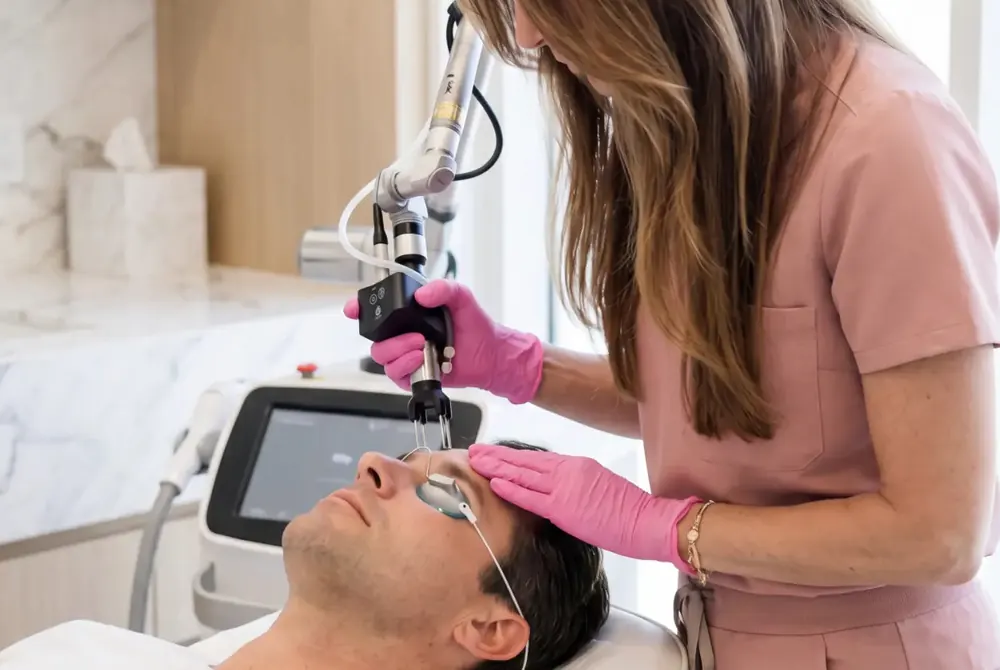
A 10,600 nm carbon dioxide laser is absorbed almost entirely by water in the skin. In fully ablative mode, that energy vaporizes the epidermis across 100% of the treated surface and delivers a measured column of heat into the papillary and upper reticular dermis.
Two things happen at once:
- Ablation. Sun-damaged, pigmented, textured surface skin is removed rather than faded, which is why pigment, keratoses, and etched lines respond so differently than they do to topicals.
- Coagulation. Residual heat below the ablated layer contracts existing collagen immediately and triggers months of new collagen and elastin remodeling.
Dr. Trott typically works to an ablation depth of roughly 80 – 120 microns of epidermal removal with an additional 50 – 100 microns of coagulation, and deepens selectively to 200+ microns in perioral and periorbital etching or in ice-pick acne scar beds. Depth is chosen per zone, not per face, the eyelid skin and the cheek never receive the same setting.
If you want the same laser at a fraction of the depth and downtime, that treatment is CoolPeel CO2 laser.
02
Who is the best candidate
Fully ablative CO2 is the right call when the problem is the skin itself, not laxity, not volume.
Excellent candidates
- Significant photoaging: mottled pigment, solar lentigines, actinic damage, crepey texture
- Fine etched lines around the mouth and eyes that filler and neuromodulators cannot erase
- Atrophic acne scarring, rolling and boxcar scars especially
- Fitzpatrick skin types I – III, where post-inflammatory hyperpigmentation risk is lowest
- Patients who would rather do one serious treatment than a decade of light ones
Not the right treatment now
- Fitzpatrick types IV – VI, or anyone with a history of melasma or keloid formation, we choose fractional, non-ablative, or microneedling with PRP instead
- Active acne, active rosacea flare, or any open infection in the field
- Isotretinoin (Accutane) use within the past 6 – 12 months
- Smokers who will not stop for two weeks before and two weeks after
- Anyone who cannot commit to strict sun avoidance for three months
Laxity is a different problem. If the skin is loose rather than damaged, resurfacing improves quality but not position, the honest answer there is a facelift or blepharoplasty, sometimes combined with resurfacing in the same setting.
03
How we prepare you
Preparation is not optional with a fully ablative treatment, it is most of the reason results look clean.
- Consultation and skin typing. Fitzpatrick type, melasma history, herpes simplex history, scarring tendency, and medication review.
- 4 – 6 weeks of priming. Typically tretinoin, a pigment-stabilizing agent such as hydroquinone or a non-hydroquinone alternative, and daily broad-spectrum SPF 50.
- Antiviral prophylaxis. Started the day before and continued through re-epithelialization for every facial treatment, regardless of cold sore history.
- Antibiotic coverage when the treatment is full-face and deep.
- Logistics planned. Full-face ablative means a real week at home. We schedule it deliberately, not opportunistically.
04
What to expect the day of treatment
- Numbing. Topical anesthetic for 45 – 60 minutes, plus regional nerve blocks for full-face work. Oral anxiolysis or IV sedation is available for deeper treatments.
- Eye protection. Metal shields, always.
- Treatment time. Roughly 20 – 30 minutes for a full face at ablative settings; 10 – 15 minutes for perioral or periorbital only.
- Sensation. Heat and a snapping sensation with cool air throughout. Deep passes are felt as pressure rather than sharpness once blocks are in.
- Immediately after. The skin is pink-to-bronze, weeping, and feels sunburned. Occlusive ointment goes on before you leave, along with written instructions and our direct line.
05
Recovery, day by day
Recovery from fully ablative CO2 is predictable when instructions are followed exactly.
- Days 1 – 2. Swelling peaks, especially around the eyes. Weeping and oozing are expected. Ointment stays on constantly; dilute vinegar soaks every few hours.
- Days 3 – 5. Weeping stops, sloughing begins. The skin looks dark and crusty as the treated layer lifts. Do not pick, picking is the single most common cause of a permanent scar.
- Days 6 – 8. Re-epithelialization completes for most patients. New skin is bright pink and very smooth.
- Weeks 2 – 4. Pink fades toward normal; mineral makeup is usually fine by day 10 – 14. Strict SPF, no direct sun.
- Months 2 – 6. Collagen remodeling continues. Texture, pore size, and scar depth keep improving well past the point the skin looks healed.
Risks we discuss honestly: prolonged erythema, post-inflammatory hyperpigmentation, hypopigmentation, infection, HSV reactivation, milia, and, rarely, scarring or ectropion with over-aggressive periorbital treatment. Depth discipline and post-care compliance are how those are avoided.
06
Results, longevity, and pairing
Most patients need one fully ablative treatment. Results become obvious at 4 – 6 weeks and continue to refine for six months. The photodamage removed does not come back; new damage accumulates only as fast as you allow it to, which makes daily sunscreen part of the result rather than an afterthought.
Common pairings in one setting:
- Resurfacing with a facelift or neck lift, position and quality corrected together
- Blepharoplasty with careful periorbital resurfacing
- PRF applied post-laser to speed re-epithelialization
- Botox two weeks prior, so dynamic lines are not re-etching new collagen
If a week of downtime is not realistic, the honest alternative is a series of CoolPeel CO2 treatments or Potenza RF microneedling. See real outcomes in the patient gallery, then request a consultation to be typed and planned properly.
Q&A